Some thoughts,stats and wisdom on the Spine Race
It is the time of year when winter “Dot-Watching” becomes almost a national pastime for some people involved in ultra running and the wider outdoor community.
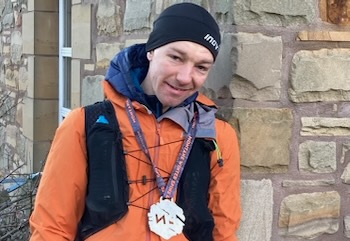
Here we offer some thoughts, and stats on this weekends Winter Spine Races, and Later on some wisdom from three former winners.
Winter Spine Race Dot-Watching link HERE
Many events now allow us to “Dot-Watch an event, but there is a strange fascination with the Winter Spine Race that seems to have placed it on a pedestal above other events.
For anyone still uninitiated, the pastime of dotwatching enables you to track the progress of competitors in an event on your own laptop, tablet or mobile phone.
It is not restricted to running events, but each competitor carries a GPS tracker, which allows their location to be tracked, pretty close to “Real-Time”, as they travel along the course.
They are represented by a “Dot” superimposed on the map of the route, which moves as the competitor makes progress. If you have an internet connection, you can now follow a race in progress from anywhere on the planet.
Several sceptics, myself included, thought it would never catch on, and after its initial introduction some years ago, the interest in spending hours watching a dot, moving on a map on a screen, would fade away as people realised they could,arguably, be getting on with other, more important things in their lives.
We were proved to be wrong, but how that has happened could fill a whole blog in itself.
Back to the Winter Spine Race,and one has the ability to dot-watch the race not just for a few hours, as happens with most normal events, but for a whole wonderful week!
What do the Winter Spine Races involve?
There are five principal races in the Winter Spine event.
* Full Spine Race 268 miles Start 8 am Sun Jan 11th Finish 8am Sun. January18th
* Spine Challenger North 160 Miles. Start 6pm Sun Jan11th. Finish at 06:00. Fri. January 16th
* Spine Challenger South 108 Miles. Start 8am Sat Jan 10th. Finish at 20:00 Mon. January 12th
* Spine Sprint North 43 Miles Start 10am Tues Jan 13th. Finish 06:00 Weds, January 14th
* Spine Sprint South 46 Miles Start 12noon Sat Jan 10th. Finish 0600 Sunday, January 11th
Incorporated into the two Challenger events, North and South are
two, “MRT” races for members of Mountain Rescue Teams.
The origins of the Spine races are well documented on the race website.
In brief, the first Full Winter Spine Races, along the full 268 miles of the Pennine Way, were held in 2012 with 12 starters and only three finishers. That year also saw the first Spine Challenger South, over 108 miles, with just one finisher.
The 160-mile Challenger North was added in 2022, along with the 46-mile Sprint North and Sprint South.
Since then, it has grown to have over 600 runners across all events on the entry listsfor 2026.
This year’s race in numbers:
Full Spine race: 157 runners on the entry list, 134 men and 23 Women
Challenger North: 105 runners on the entry list, 81 men and 24 Women
Challenger South: 160 runners on the entry list, 122men and 38 Women
Sprint South: 123 runners on the entry list. 91 men and 32 Wom
Sprint North: Unkown numbers.
Can you predict Finishing times?
Any Spine runner will tell you, it is very difficult, if not impossible, to predict times or winners. Running 268 miles on undulating terrain is never easy. Throw in winter conditions, sleep deprivation and ongoing fatigue,which can affect the way you think about and deal with yourself, and even the most experienced runners, going well in the early stages, have come to grief as the race progresses
Although the race rules make it a “self-supported event”, with no outside help permitted, it has a great reputation for looking after all competitors at every checkpoint, where runners’ kit bags are also transported to and from, as the race progresses.
Nonetheless, the event is billed as “Britain’s most Brutal” for a good reason. It tests not just one’s outer physical capacity, but also one’s inner resilience as well.
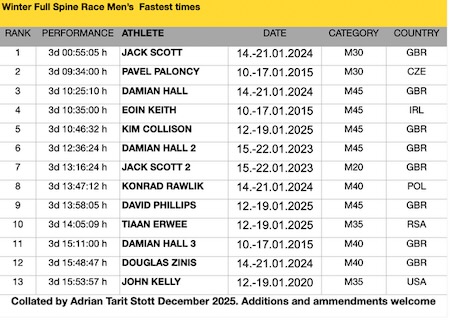
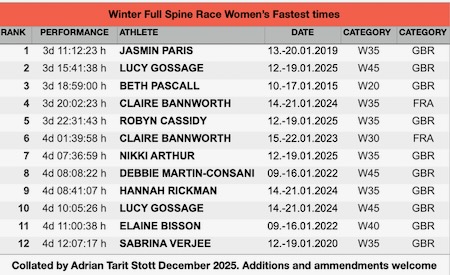
Full spine race Men’s fastest times
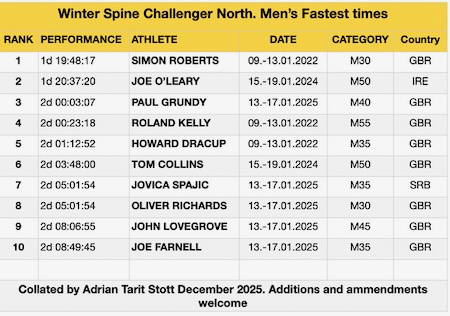
Winter Spine Challenger North. Men Fastest time

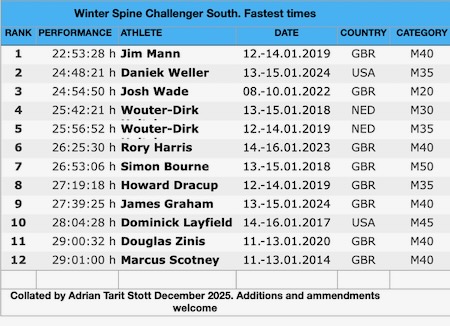
Winter Spine Challenger South. Men Fastest times
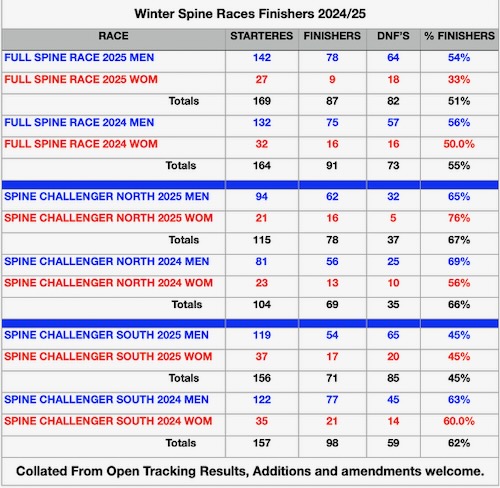
Percentage drop out rate 2024/5
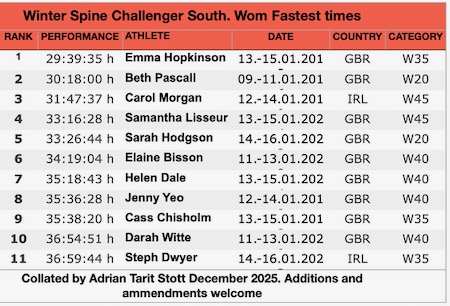
The weather and underfoot conditions vary so much from year to year. A quick analysis of winning times at all distances shows a great discrepancy from year to year. It makes the winter Spine races, very much a case of “Just deal with what is in front of you each hour” from checkpoint to checkpoint.
This is evident in the high dropout rate every year, from both elite runners trying to be competitive with each other to the majority of the field, who just want to be competitive with themselves.
A look at the success and drop out rates over the last two years and it shows competitors in the Full spine race have roughly a 50% chance of finishing. For the shorter challenger races chances are better but still averaging over a 30% drop out rate.
Simple Spine Race advice from three former Champions
2024 winner Jack Scott had fairly good conditions in his record run. His advice was
“ The key to the Spine race is not a special piece of kit or any special training you have done. Don’t get me wrong, you need to have a bare minimum of mileage and all the usual kit to keep yourself safe. It’s really something you can’t touch, and that’s resilience and patience. If there was ever a race where those two qualities needed to be at the top of the list, then this is it! At other big races, you need fitness, of course, but for the Winter Spine, these are more important than your fitness and conditioning. So patience, resilience and an appreciation that you have a chance to be out there and finish a race, that most normal people don’t comprehend really!”
Jasmin Paris, who probably brought the race firmly to a much wider audience with her record-breaking run in 2019, offered this advice.
“Don’t set off too fast, put on more layers before letting yourself get cold, and keep eating! And beyond that, it probably depends on what you are aiming for position-wise, but pairing up and running with another person/s is great for morale and navigation, especially at night and in bad weather”
Last year’s winner, Kim Collison, is not running this year as he has an upcoming appointment with the Arc of Attrition 100 in two weeks. He was his usual cheerful and down-to-earth self when simply commenting. “When you are in your darkest moment. Shout out loud into the abyss. “YOU CAN DO THIS!”
So! Let the Winter Spine dot-watching commence. I shan’t be tuning in 24/7, but I am sure I will be checking in periodically to see how those dots have moved, and are moving along the course of the Pennine Way, while trying to imagine the terrain from the contours and features.
For further Spine reading
Read a chat with 2024 Spine winner Jack Scott HERE
Read A chat with 2025 Spine race winner Kim Collison HERE
Thanks for reading. If you have enjoyed this post, do see our other ones HERE
If you have a comment, please feel free to add it below.
If you are inspired by this, or think someone else you know will be, please do what you have to do by sharing. You all know how these things work by now:-) You can also follow me on Twitter and Instagram @tarittweets
Sign up to receive our newsletter alerting you to new posts
Adrian Tarit Stott.
The author is a former GB 24-hour ultra international with over 100 ultra race completions. He has also been involved in organising ultra-distance races for over 30 years. Still an active recreational runner, he is currently a member of UKA’s Ultra Running Advisory Group (URAG) and the Mountain and Trail Advisory Group. He also contributes as part of the selection and team management for both Scottish and GB ultra teams. A freelance writer in his spare time, he contributes articles and reports to several websites and magazines including Athletics Weekly and Irunfar.


