Tim Noakes, the author of The Law of Running, has a theory. If you multiply your half-marathon time in minutes by 2.11, you get your predicted marathon time in minutes. Another study suggests taking your average minutes per mile, adding 20 seconds and multiplying by 26.2.
I am sure in this age of ever increasing sports science, many studies by professors, coaches and sports science students have helped devise an easy to understand formula. Similar formulas have been put forward for 100 kilometres. However, as the distance increases, there are, in my experience, too many variables to make predictions that sit easily. Possible variations include wind and temperature, nutrition, the severity of the course, the strength of the competition, and personal experience.
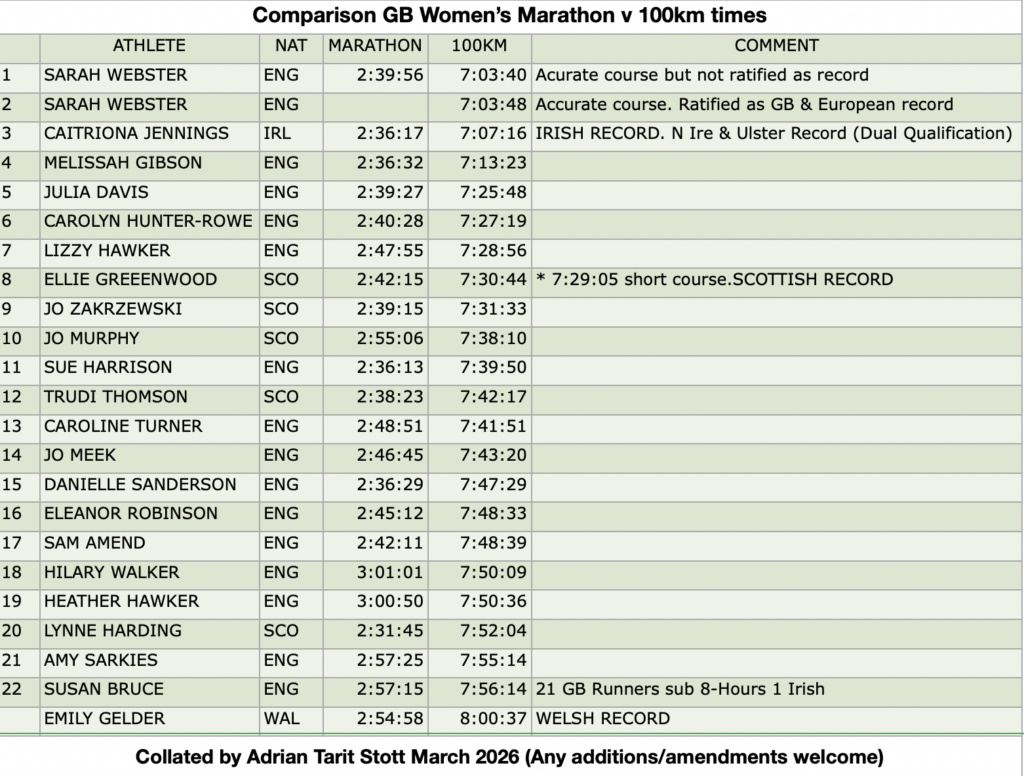
However, if you were to look at their form around the time of their best 100k performances, you would see most had a few years of consistent quality racing and training. This training enabled each runner to learn through experience, not how to run an ultra, but how to race an ultra event.
It is a verifiable fact that most of the top runners’ times here, apart from a few exceptions, were achieved in a World, European or British Championship event. In most cases, individual or team medals were at stake. Hunter-Rowe, Hawker and Greenwood managed to hold off strong opposition to strike gold, indicating that strong competition is a factor in performance motivation.
One notable outlier here is Hilary Walker. Of all the women who have run 7 hours 50 minutes or less, she is the only one who hasn’t broken three hours for the marathon. This is mainly because most of Walker’s marathon times were run within a training block for an ultra race without any serious tapering or marathon specificity. She achieved many excellent ultra performances, but on her own admission, she never had the natural speed of others, but could indeed maintain a steady pace for several hours. Preparing for ultras when she was at her best always took priority over consciously improving her marathon time.
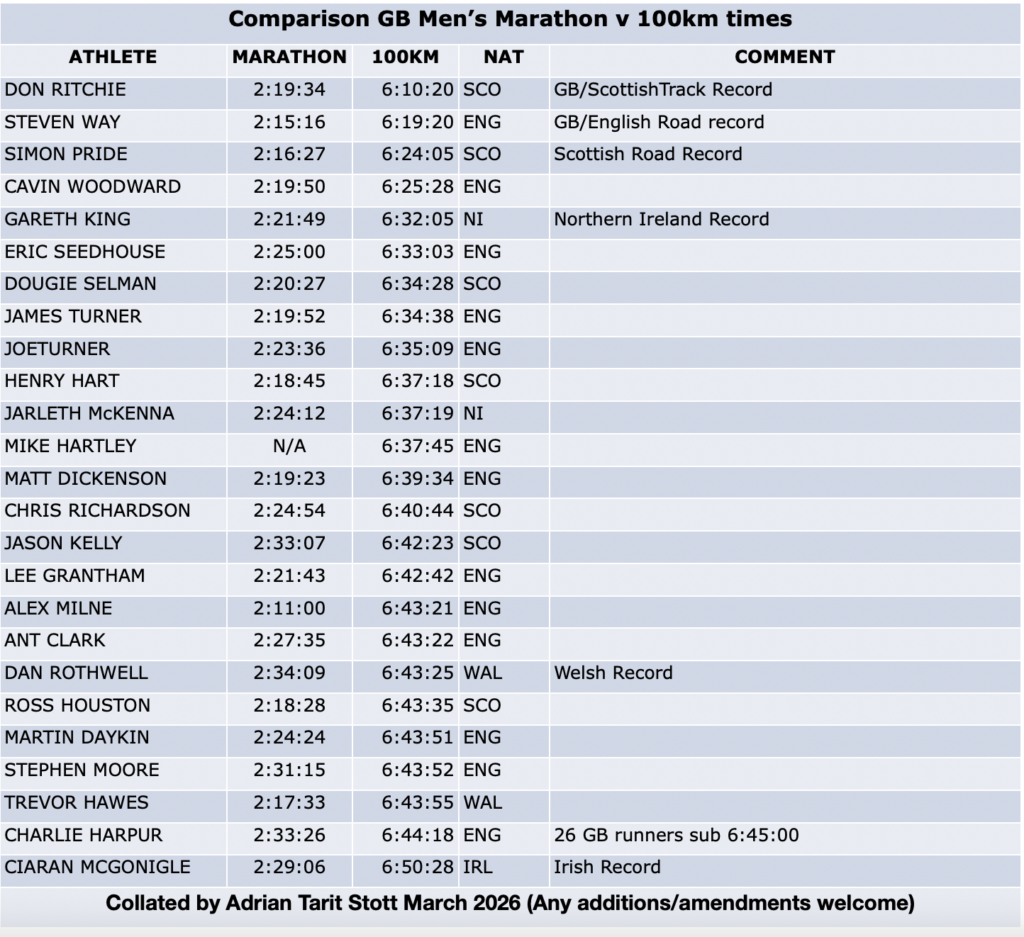
Contrastingly ,Dougie Selman, Alex Milne, Henry Hart, Jarlath McKenna,and others who have some of the fastest men’s times in the last few years, all ran relatively even splits in their best 100km races.
Llke Hilary Walker, some of the mens times are probably due for revision when they choose to focus specifically on a marathon for a few months.
- The “perceived myth” that training for an ultra will lead to you running slower marathons is just that.
- `For several of the runners listed here, men and women, their fastest marathons were run once they had an ultra background. If the speed/endurance mix is right, history shows that good marathon times and good ultra-distance times up to 100km can be mutually achievable.
- Although there are exceptions, Sarah Webster being one of them, it is unusual to run your best 100km at your first attempt. As with the marathon, experience learned, usually leads to an improvement in subsequent races.
- As stated earlier, this can apply not just at the elite level, but whatever your standard is. Only slight tweaks in training from a successful marathon schedule are required to run a competent ultra up to 100km distance. More important is a few years of consistent mileage and adaptation to the demands that marathon and ultra training have on the body. The same applies to someone from an ultra background who wants to focus on improving their marathon time.
- It goes without saying that at this time, when so many runners and coaches are using “Zonal training”, your ability to hold your estimated optimal race pace in a long/medium training run can give personal feedback on your realistic goals and provide an insight into your own windows of where your plan A, B or C should lie in a 100k race.
- Don’t neglect the importance of nutrition. While it is very individual and there is no “off the shelf solution” the ability to “train your gut and digestive system” to take on board sufficient input, when running at a good intensity, needs to be practiced well in training.
- Along with the necessary and inevitable hard, physical outer training, there is always the X factor of the “ Inner training” or what I have loosely observed as a runner’s ability to problem solve, or just ”Deal with themselves, in the moment, on the move”. There is a priceless ability, honed over many years through personal experience and the wisdom of coaches or good friends, to be able to just observe what is happening to your body during a race, recognise it, and adapt pace or fuelling to keep on track.
- There is also a priceless ability with marathon runners, and especially ultra runners, to recognise that on a given day, absolutely everything has fallen into place. After the necessary ritual of feeling your way into the race in the first hour or so, it’s then essential to resist the temptation of telling yourself, “I am feeling so good I could increase pace here.”
- Much better to be patient and maintain an even pace, as others who weren’t so patient start dropping back to you as you reach 75km. You sense you are working harder, but in reality, you are just maintaining an even pace, while the effort required to do so is becoming apparent.
- Once or twice in a lifetime,there are those rare days when you might just consider ,knowing there will be so few days in life like this, to just throw caution to the wind at some point, and go for it, knowing things might get interesting in the later stages, but you know you have the training behind you and the tools to deal with it. Those are the days, whatever your standard, when magic happens.
This post is an update of a previous post
PLEASE SHARE!
If you have enjoyed this post, do see our other ones HERE
If you have a comment, please feel free to add it below.
If you are inspired by this or think someone else you know will be, please do what you have to do by sharing. You all know how these things work by now:-) You can also follow me on Twitter and Instagram @tarittweets
Sign up to receive our newsletter alerting you to new posts
Adrian Tarit Stott.
The author is a former GB 24 hour ultra international with over 100 ultra race completions. He has also been involved organising ultra distance races for over 30 years. Still an active recreational runner, he is currently a member of UKA’s Ultra Distance Advisory Group (URAG) and part of the selection and team management for both Scottish and GB ultra teams.He is also a freelance writer, contributing articles and reports to several websites and magazines including Athletics Weekly and Irunfar.


