
Logan Rees, Scottish 5km Champion.

A couple of weeks after his win at the Sri Chinmoy 5km race at Silverknowes in Edinburgh,in a new course record 14 Minutes 04 seconds, which incorporated the Scottish Athletics 5km Road Race Championships, I had a chat with Logan. What I had envisaged as a short chat around the race, seemed to develop into a wider chat on his time in the USA, training, shoes, the Scottish distance running scene in general and his short and long term goals. His Fife roots are also apparent throughout.
AS. Who is Logan Rees? Where are you now? What are you doing? What are you doing for work at the moment?
LR. I’m living in Crail in the East Neuk of Fife, but I’m working in St Andrews at a high school. I work in the office doing general administrative tasks. It’s pretty regular work, which gives me time to fit running around that. It’s very convenient for what I’m trying to do.
AS. Which leads me seamlessly on to my next question. How does that all fit around your running?
LR. Pretty well. I get to work in a comfortable, warm office with a good lunch break and a canteen. I’m not on my feet all day doing strenuous activities. As long as I can get up early enough to run and then run again in the evening, which in the winter is a pretty dark endeavour, it’s good.
Early running
AS. Briefly tell us about how you got into running. I can remember you as a junior running East District cross-country leagues and things like that, but tell us how you got into running with Fife AC and how it all developed before you disappeared to the States.
LR. I’ve told this story before, and it’s important. My sister was very active. She is older than me. I’m one of four, and she is the oldest. She was an active wee girl and was very naturally talented in sports. She took part in a race, which I think still exists, called the East Neuk Primary 1K. It is a small cross-country race in Pitenweem, one of the East Neuk villages. She won that just by being an active child without any really committed training. Well, not that anyone should be doing training when they’re seven years old or whenever it was. She was just interested in the sport, and my parents asked around on her behalf. We discovered Fife AC, which I think benefits from being quite widespread in its reach. There are different pockets that represent Fife AC. There is the North Fife group of Cupar and St.Andrew’s which we are not actually in but is not too far away. Then there are also groups in Kirkcaldy and Dunfermline, and a Glenrothes group as well. That’s how my family got into running. My sister started, and I just followed along. Then, my two younger brothers followed. So, it was a real family pursuit.
AS. Is your sister still running?
LR. Yes. She’s a teacher up north and still runs for Fife. I think she will always run for Fife, regardless of where we live in Scotland. So yeah, she’s still running.
AS. Did you graduate from Edinburgh?
LR. Yes. I spent four years in Edinburgh.
AS. What did you study?
LR. Plant Sciences in the School of Biology.
AS. And then you went to the States?
LR. Yes.
American Adventures. Surgery and recovery.
AS. Briefly, how did that come about? What motivated you to uproot and go to the States?
LR. Definitely the running. I was aware of people going to the States to compete or to do sports generally. I was never really at that level coming out of high school when I was 17 or 18. It took me those four years at Edinburgh to reach a standard where I became attractive enough to warrant getting a scholarship and getting all the assistance that gets your place there. I also wasn’t really sure of what I wanted to do professionally in terms of work, so it seemed a good thing to just keep running with that level of support. I didn’t really think very long about it. I was like, “That’s a good thing to do.” The biggest decision wasn’t whether or not I was going to go, it was where I was going to go within the States. There were a couple of options.
AS. Just briefly, but for anyone else who might be thinking of going to the States, what were the driving factors between choosing between those two universities you had?
LR. For me, a big part of it was the geography. I was probably approached by 10 or 12 different places. I quickly whittled that down to three or four, with performance playing a big part. The ones I was looking at were the top in the year I went there, on 2018 and 2019 results.
They were in the top 10 or top 20, for distance running, which was good, I’m a very pale Scottish ginger. I don’t think me being in the South would have been a very good idea in terms of my health.
And then part of it, and maybe a bit pretentious of me, was that I didn’t really want to go somewhere that a lot of Scottish or British people had been before. I kind of wanted to do my own thing slightly and not just follow what had been done before, which I do concede is a slightly unnecessary thing to consider really. I just wanted it to be my own adventure. So a combination of the performance side
of it, the geography of the place and how exciting the town looked from a more cultural perspective all contributed.
AS. Compared with the club and the university scene here in Scotland, how does it compare?
LR. It is comparable, but not very closely comparable. It’s a very different kind of set-up, and a different culture entirely in terms of how your day, your week and your studies work around your training. Having grown up in Fife, Scotland, I was used to getting up early and running before school, and then before university, and then after university. After class had finished, you know, running down to the track and stuff like that. That was what I was used to. Whereas in America, the sports coaches said, “This is when training is. Choose your modules, choose your classes, and choose your lectures around this availability”
So, you needed to be available at whatever it was, 2 pm on a Tuesday and a Thursday, so don’t choose classes that make that impossible. It was just completely the other side of the priorities I had been used to. Whereas, at Edinburgh University or high school, you just get up at six and run before class, and that’s what you do. Now I am back here, I need to run before or after work. That’s the way that it’s done.
AS. Performance-wise, the US didn’t do you any harm. What did you study in the States? What degree did you do there?
LR. A Master’s in biology. I kind of went for a slightly more general degree than the specific side that I had at Edinburgh. It involved more of the conservation kind of ecology and biology compared to the more molecular focus I had at Edinburgh. It’s still within plant sciences and botany, but just a different focus.
AS. Running-wise, obviously the States didn’t do you any harm. I think you got your track 5km PB down to 14:02 and your 10km to 28:14. Your road times were okay, too. When you ran those PBs then, did you feel you were at the max with the training block you’d been doing, or did you feel there was more to come?
LR. Good question. I think I was hindered in my final year in Edinburgh, I didn’t run at all in that entire academic year. The kind of level of support in terms of physio and treatment that I was getting in America, helped me get back to a level where I could run nearly pain-free. I had an ongoing Achilles issue. It came to a point where I decided, and the coaches at the set-up in America decided, that I needed surgery, which I received in December 2019. So only a few months after arriving in America, I ran that cross-country season and then had Surgery.
Then, as a bit of a selfish blessing for me, COVID struck, which meant that there was not much going on that I was missing because I was in a boot. I think if I’d been spectating the whole of 2020, with people competing and racing every weekend, I wouldn’t have enjoyed that as much, but everyone was in the same boat. I recovered from the surgery through 2020.
The combination of a whole year in America, as well as a whole year when I was still in Edinburgh, and running with an injury, left a slight gap in my ongoing training. The times I was running in America were really quite recent after those gaps in my training. I was probably at the peak of what I could have done then, but I was still building consistency.
Current Training set-up.
AS. Tell us about your training set up in Fife at the moment.
Are you still coached by Ron or anyone at Fife?
Note: Ron is Ron Morrison, from St Andrews, one of the well-respected, senior endurance coaches at Fife AC.
LR..I’m not. When I left the university I was at in America, I joined a local group called the Idaho Distance Project. It isn’t as substantial as they were but is still ongoing. They were coached by Kameron Ulmer and I’m still coached remotely by Kameron who sends me stuff to do. I was with Ron for 10 years or so, and I still see him most weeks. He gives me guidance and advice, but the specifics of my training come from Kameron remotely.
I was under his tutelage for a time when I was quite successful by my own standards. Moving back to Scotland from America, I knew I was gonna go through a lot of changes in terms of my life both professionally, and socially. I just wanted to keep something consistent. So I was like, well, I’m not going to make another change. I’m just going to keep being coached by Kameron. So that’s what I’m still doing. A lot of, nothing very exciting. Not many young people live in Crail, so I do a lot of mileage on my own. I do a good amount with my dad a couple of times a week, which is nice. But I am just doing pretty normal stuff, threshold stuff, speedy stuff.
AS. Do you do the odd session with the club, or do you do all your hard sessions by yourself?
LR. I probably do 90% of the runs I do on my own. Occasionally, I’ve headed to Edinburgh and run sessions with some people there. I have also gone across to Glasgow and trained with Scot Stirling a few times, but most of my training is on my own around Crail.
AS. In terms of planning a year or part year, do you pick your own goals, or do you talk about it with your coach? Does he suggest goals? How does that work in terms of bouncing ideas off each other and planning how you can reach your goals to try and take things to the next level or whatever?
LR. Good question. I think I’ve had the same kind of overarching goal for some years now, which is breaking 28 minutes for 10k. That will be my goal until either it happens or I stop running that one. Then, every year, the Scottish National Cross-Country, at Falkirk is my big thing. So everything else is structured around trying to run a fast 10K in the summertime or on the road and then, that weekend date in February at Falkirk. Everything else must fill in the gaps. You know, I really like the Scottish scene. I like being back in Scotland and running the East leagues and the district champs and all the road races throughout the year, but they’re all geared towards those two big goals for me, which are running a good 10k and the Scottish National Cross Country.
AS. Apart from running, obviously, what background stuff are you doing just now in terms of gym, strength, hills or anything here?
LR. I’m not doing any gym at the moment. I did for a few years. I’ve probably not done any for two years. I do cycle. I’ve only recently started commuting to work again,which I do on the bike. My commute from Crail to Andrews is almost 10 miles each way, exactly.
That’s 20 miles a day of pretty easy supplemental excercise. I’m not pushing it. Finding time for cross-training, on top of running is a challenge.
AS. What do you do with the weekly mileage just now, or at various times of the year generally?
LR. Pretty much 100 miles a week. That’s a very regular mileage for me. I just keep it at that. I experimented with some higher mileage stuff last summer, which I’ll probably replicate as a pre-season cross-country block. I got up to 120 miles low.
I try and keep it up there for a few weeks. A good 10-week block in August and September in advance of, November and December, when I have some big goals. It’s taken me a while to get to consistently be able to do 100-mile weeks but I’d say over the last three years, I’ve probably gone over 100 miles more often than I’ve gone under. So sticking with it.
I always think of it as, “If you do 100 miles, there are ways of doing 100 miles within a week that could be drastically different if you only run once a day.”
That’s a completely different kind of proposal than running two times a day. I maybe run 10 times a week, so that’s an hour, you know, or a 10-mile average. If you were to run a seven-mile average, but then run 14 times a week, you’re looking at just a completely different toll on your body. So yeah, it’s the kind of interesting concept that I think about a lot where it’s like, “Do people run 100 miles a week because it sounds cool? Or is that actually the limit? Or your body doesn’t even know what your limit is. It’s an interesting rabbit hole to go down with many possibilities and ways of doing things.
The Importance of Championships
AS. It’s all interesting and It’s a good philosophy. So you’ve kind of answered this question, but championships are obviously important to you, majoring in the National. And you obviously sort of targeted the 5k championship. Are championships just as important as trying to get fast times to you in the overall picture?
LR.Definitely. I think I’m aware of myself and that I know I’m not going to win a British championship or anything bigger than that. The way I was raised in the sport and the way that I grew up racing a lot of stuff, it’s like Scottish championships are always important and I’ve been having a few conversations with various people about it actually. It’s like on the top of my pyramid is the National Cross-Country. I think that’s the top, and then there’s a sort of second row of races, of which I would put the Sri Chinmoy 5k champs in that. I’d maybe also put the Tom Scott 10, the short course cross-country champs and the outdoor track. Then maybe there’s a third tier below that of things that I’m maybe just not as aware of, but all of those things are important regardless of where they come on this hypothetical pyramid of importance. I always grew up knowing the importance of the Scottish Championships.
Silverknowes is always a big one for runners to aim for.
The Sri Chinmoy 5km at Silverknowes and how it panned out this year.
AS.If you know the history. We’ve been organising races at Silverknowes for 30 years. I think when the Scottish Road Race Grand Prix series started, it was Alex Jackson who asked me, “Can you host a 5km championship at your race?”
The other championship distances are all incorporated into other races, which are great events. I am probably biased, but the 5km just seems to have grown to have a great buzz around it, bringing hundreds of club runners together for a great racing experience.
LR. That’s awesome. It’s certainly a great race.
AS. Talk us through your race this year. I mean, with a few exceptions, a lot of the top guys were there. When we went to set up around half past three or four o ‘o’o’clock, there was a really strong breeze by the river. I was thinking, “Oh, my God, they’re not going to break 14 and a half minutes this year. But the wind seemed to drop round about seven o’clock. It was still there, but it wasn’t quite as strong.
Did you go into the race with a time in mind, or just wanted to win?
LR. I only wanted to win. I didn’t really care for the time, and that was what informed my tactical choices. I’d rather win in 16 minutes flat than come second in, you know, 13.40. I had a great cross-country season, but I’d lost a couple of races recently, which I hadn’t done in Scotland for a while. So, I wanted to get back to a win. That was really important, but then, also just the importance of this race on its own. As I said, I have run it before, but not for a few years with being in the US, and then with injuries and stuff. So it was one I really wanted to win. That was the biggest thing for me. I didn’t want to force the pace and didn’t want to take the wind. I think that panned out exactly the way I wanted. I didn’t ever really face the wind. I was in the lead for a period but with the tailwind. So, I didn’t really face the headwind until the last stretch to the finish. Maybe that wasn’t a very nice way for me to win a race.
AS. It’s a classic racing strategy.
Did it help to have a bunch of guys there all seemingly working together?

LR. Yes., it was a good group. It’s difficult because the straights are so long when you get to them. You don’t really have an opportunity to look and see who’s behind you. And the way that the wind was carrying noise, the spectators were cheering on individuals. I didn’t know if they were one second behind or 10 seconds behind. I would hear names, and I assumed there was a group of 20 of us.
Then, looking at footage and photos, there was a period where there were maybe three or four of us. The two Cambuslang guys, and then me and Ben had a bit of a gap, which I wasn’t really aware of.
Having that volume of guys, definitely through that first mile or so into the wind, was good. I think we were all kind of conscious of each other and didn’t let any one person do the work too much. It was windy, and no one wanted to sacrifice themselves for it. It seemed like everyone took maybe 10 seconds at a time, just slightly rotating, which was cool.
AS. Any idea what your splits were for the race in terms of kilometres or miles?
LR. I don’t know my own, but I know that someone in the second group thought we were on a low 4:20.
Maybe 4:20 even, with the benefit of that tailwind. That was probably the quickest mile I ran, which is cool.
You can see results of the 2025 Sri Chinmoy 5km are HERE
and a report of the race HERE
Geeky Running Shoe talk.
AS. This is a geeky question I ask several people. What shoes were you wearing for the race and what do you train in? The world wants to know these things!
LR. I think they are the Vaporfly 2’s.
Since I left university in America, I’ve been getting all my shoes off eBay.
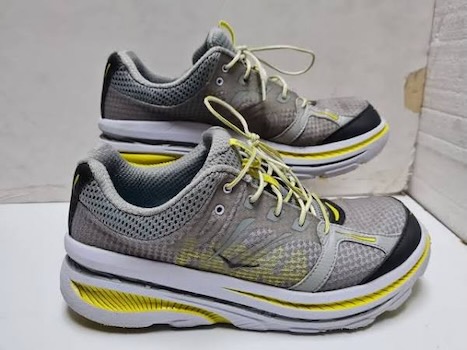
I’ve been wearing the Hoka Bondi as training shoes for a long time, and I love them. When I started wearing the Bondi, there was genuinely a massive change in my pain levels and therefore, my happiness and my running.
With the version 8, I realized it wasn’t as chunky as the version 7. Sorry, this is really nerdy, but it wasn’t as supportive for me. I found issues, like I said, with my Achilles, my feet and other stuff coming back. The stack height and level of cushioning seemed to decrease too. So, I started searching around for older models and ended up having to get them off eBay. Often slightly used by people that had maybe bought them, but in the wrong size and were reselling them.
So I started buying Bondi’s on eBay and then from there, it was like, “Oh, well, I could probably do the same thing for racing shoes and started doing the same.
Buying from people who maybe raced one marathon in the Vaporfly’s and then decided it wasn’t for them.
You’ve still got a lot of life in that shoe, but the price has decreased massively because it’s been worn outside. So I got some Vaporflies off of eBay. They still work fine. Yeah, they’re a good shoe. I’ve not dabbled in many variations because I’ve been pretty set on Hoka for my daily trainers. Where I was at university in America, it was a Nike-sponsored school. So all of my racing shoes have been Nike and I’ve just kept that consistent.
AS. I was involved in running retail for 30 years, so I’m also a bit of a shoe nerd myself. There’s a funny story about yourself and Run and Become.
NOTE: I helped look after the Run and Become running store in Edinburgh for many years with shoes as a major interest.
Run and Become in Edinburgh, was one of the first stores to take Hoka shoes into the UK. There was a guy, Steve Cooper, down in the Lake District about 2011, 2012 I think. When Hoka first came on the scene. He was a UK distributor for a few small sports brands at the time when Hoka first came on the scene. He took a commitment to be Hoka’s first Uk distributor
He came across Hoka through his contacts in the trade and took a commitment to be Hoka’s first Uk distributor.
Anyway, he just called me up one day and said, “I want to bring you a new shoe that is making some waves and get your views on it. He brought me up one of the original pairs of Bondi’s. My first reaction when I saw it was, “What is this? It’s silly and wacky looking with awful bright colours and a ridiculously looking high stack height compared with everything else at that time. It looked like something an 80’s glam band would wear.”
He just said, “That’s your size. Just take it. wear it for some miles and just tell me what you think of them”. After a couple of weeks, I was sold on them. They were weird to start with but they quickly grew on me. We took them into the shop and once word got out they soon proved popular. As one of the handful of running shops stocking them in the UK people were coming to try them fromallover Scotland and the NE of England.
I remember most of the guys and girls coming to buy them were ultra trail and mountain runners doing crazy things. The two French guys who developed them were ultra-runners themselves and that was the runner profile they were pitching at initially.
Most of them were in their thirties, forties, and upwards. Then one of the staff, actually my daughter, remembers you coming into the store and telling me, “One of these young University runners came and bought a pair of Bondi’s today” which was way against the trend. We all found that a little strange.
It was quite radical that this young guy from the Uni Hares and Hounds was coming in and buying a pair of Bondi’s.
. You actually got a nickname as the “Bondi Boy”.
LR. I’ve probably kept coming back. That’s a good story. I didn’t know I had a nickname like that.
AS. You were ahead of your time and its quite remarkable how Hoka have grown to become a global brand in that time.
LR. I was friends with a guy, well still I’m friends with a guy who worked in a running store in America, in Idaho where I was, and he said I was the only runner that came in to buy Bondi’s. All of the other sales were for older people who would wear them to the barbecue or to go for a walk or something. They became this kind of cool person, fashion shoe, for comfort and no one runs in Bondi’s anymore. I was like, well, I’m staying true to it. The Bondi version 9 looks good. It looks like a return to the previous Bondi’s that I first attempted my running in. Version 8 has been a bit funny, but I like version 9.
AS. Ok We’ll leave shoes there as it feels like we could talk all day about them
NOTE: Hoka shoes were developed by two frenchmen Nicolas Mermoud and Jean-Luc Diard. Both were experienced runners with many years working designing and developing sports footwear. Around 2010 when many shoe companies were pursuing more minimalist designs, they bucked the trend by coming up with a “Maximalist shoe”. A trend many major shoe companies have now followed.
The 5km Running scene in General just now
Back to 5k racing and the five-kilometre scene in general in Scotland and the UK. You have the Armagh 5k in Northern Ireland that everyone wants to go to to get fast times.
Here in Scotland, we’ve got our Sri Chinmoy race at Silverknowes, which is quite a good little niche thing. Callum Matthews is developing his Stride set-up with the Flat ‘n Fast 5k races at the cycle track in Linlithgow. PH racing club in Dunfermline have their QA5 race.
Then down south, you’ve got the Podium guys doing their thing, which is, dare I say, slightly more commercial, to be diplomatic, but providing good race opportunities. Then, you’ve got people like the Run-Through team who seem to be getting involved with races at several distances all over the country.
LR. I’ve never done Armagh because of that timing because my biggest day of the year was 10 days later.
NOTE; The Armagh 5km is usually just a week or so before the National Cross country Championships.
AS. So I guess what I’m trying to say is a little 5k scene has built up over the last three, four or five years. How do you view that? Do you see it as something positive? Or is it just making people run too many races? Some of them do have fast times in-depth, yet for some of them, you might get one or two guys running fast, and then there might be a gap to the next few runners.
LR.Again. It’s a good question.
I am not sure I have an answer.
I’m not sure if this is apparent, but I’ve raced a lot since I got back to Scotland, and that has been something I’ve been really keen to do. So I think, you know, as long as you can prioritize what you do within each race and take the losses and the wins and make good use of every race, I don’t think there’s necessarily a risk of racing too much. I think the more races available to people, the better. I do wonder, you know, I think the Silverknowes race gets a lot of hype because it is the championship. I think, like we talked about, running a good time is one thing, but then there’s the victory, which comes along with that.
So, I think for races to be relevant and useful, they should either be a championship, which is obviously important to a lot of people, myself included, definitely, or they should be fast. And as long as one of those two things is available, it’s got to be a success regardless of who shows up,
It doesn’t matter if a race is won in 14 minutes flat, or 14:04, or it’s won in 15 minutes. If that’s someone’s level, and if someone is running as fast as they can, that’s great.
AS.From an athlete’s point of view, is there anything that could be done to improve the scene at the moment? Would prize money help, or some coordination of dates, so the calendar doesn’t become too crowded?

LR. Personally, no. I think the calendar works very well in terms of where everything is spaced. I’ll probably talk about this ad nauseum now and probably get a bit boring. I think in Scotland, it works fine. Scottish Athletics and the Scottish running scene does a really good job. I don’t know how this has happened over many years, but there is a good culture of recognizing the importance of Scottish Championship events.
You could charge people £100 to race, and there’d be no prize money, and it’d be a terrible course that’s, you know, that’s slippy and gravel and crowded or something.
But if there was a Scottish Championship on the line, you’d get a good field because I think, as runners in Scotland, that’s always going to be a big deal. And as long as the Scottish Championships keep going, then whatever race is designated as the championship in whatever distance is always going to be a good one. I think that’s important. I think maintaining that is a really good thing.
AS. Going forward, obviously, you’ve alluded to this a little bit earlier, but what’s next for you? Are you going onto the track in the summer or looking for faster road times come the autumn?
LR. Definitely the track. I am running the British 10,000 metres in two weeks with the hopes of finishing highly, but more importantly, running a good time. It’s been nearly two years since my 10K PB. So to break that would be great. I don’t know what level I’m at at the moment. I should be in my personal best shape, but I don’t really know how that lines up with the rest of the field at the moment. Sub 28 would be nice.
What are Logan’s goals looking forward?
AS. Looking ahead, obviously, cross-country is important to you. You were unlucky at the trial this year down in Liverpool. You had a little incident with your shoes, I think.
LR. Yes. Kind of got suctioned off my shoe in the first half mile.
AS. You’ve obviously won Scottish Vests. Is the carrot of a GB vest at cross country still there and real for you?
LR. I said this before, maybe publicly, when I got surgery on my Achilles, “I’m going to make a return to running. This is going to be a pretty tough comeback. I’m going to be some months building back which actually turned out to be over a year of basically not running at all. So the question was “What do I want to do when I come back to it?”
Winning the National Cross Country at Falkirk was one goal which I’ve done, which is great. Breaking 28 in the 10k was the other and then representing Great Britain was the other one.
Then actually there’s one more which other people outside Fife might not relate to but winning the Devil’s Burdens Relays with a Fife AC team is up there as well. So those were the four.
AS. Laughs. So you have won Fife’s two long-term Classics, the Black Rock 5 and the Cupar 5. Now, you’ve got to go and win the Devil’s Burdens Relays!
NOTE: The Devils Burden Relays is a 4-leg team relay, running over the Falkland Hills in Fife. It is a very popular event in the scottish calendar, taking place in January each year.
LR. Yeah. That race means a lot to me. It was one of the first races I did as a seven-year-old. One day, we’ll get a Fife AC team that will win. I think my best shot at representing Great Britain is probably cross-country, just because of where my strengths are. Also, that’s quite a big team that goes. It’s not a two-person team. It’s a six-man. That suits me.
AS. Tangentially, one year in the very distant past, in 2018, when you were still a junior, you ran several races on the hills and did quite well, even gaining a Scottish vest for the Junior Home Countries International that year
LR.Yes. I grew up on the hills.
AS. So, could going back to the hills be another possible GB scenario in the future?
LR. The Hills are something I miss. That was what I did growing up from the age of six or seven till 17 or 18. It was cross country in the winter and then hill running in the summer. I didn’t really do track or road at all until I was maybe in my second or third year at Edinburgh Uni. That’s when I started to do flatter stuff on different surfaces. I didn’t really stick with hill running enough to have done what I consider to be the kind of big races on the Scottish scene. I definitely want to do them at some point.
I don’t know how long my capacity for enjoying running and sticking at it will continue. I don’t know how many years it’s going to be until I realise that either I’ve achieved the goals I set, or that I just can’t do them anymore.
From that point, will I then want to pivot back to hill running, or will I just be done with everything? That would seem like a bit of a shame though, because it’s a whole scene that I’m aware of and grew up running. The junior versions of the events, like Ben Lomond and Carnethy,
I’m also aware of the bigger hill races and want to do them. Not necessarily to win things, but just to experience them.
The Marathon Experience.
AS. Looking at your race history, I think in 2023, you managed to sneak a marathon in at the end of the year.
LR. Not with great success.
NOTE: Logan ran 2:24:24 at the Sacramento Marathon, Califormia, in Decemebr 2023.
AS. What motivated you to do that? Is that a route you might pursue going forward and running a decent time sometime?
LR The motivation was the American scene actually. I was in America for five years. For three years, I was at university, and then I stayed in Idaho, which is a great place to live, train and work. However, it doesn’t have a massive winter cross-country scene or even a road-running scene. It’s generally a very different culture, not just unique to Idaho, but America. There isn’t that kind of sub-elite pocket of distance running. The professionals at the very top end are very, very high. Then, there’s a bit of a gap in comparison to the UK and Europe. Sub-elite people who are working full time but are still training, still trying to make the best of what they can do with their professional work life going on. There isn’t really the scene compared to my winter in Scotland, where every weekend I would have to travel not very far to do a very high-quality cross-country or road race. So I think that kind of set-up in America, the lack of that, lends itself to marathon training because you can have this big training block, which builds up to a single event, after 12 or 13 weeks or something.
Also, just because I was keen to give it a try, you know, that’s definitely part of it as well. So, I attempted a marathon at the California International Marathon in Sacramento. I actually attempted one the year before the one that you mentioned, as well.
I think I often get quite excited in races and start at paces that are beyond my ability, which usually is fine if it’s a 5k or 10k because you can’t really get found out. The marathon didn’t take any prisoners in that regard. I went through halfway at about 65:50 or something.
That was obviously too fast, and never having even run a half marathon before, I kind of crashed and burned about 20 miles into that one.
I felt like I wanted a bit of revenge, so went back the next year. A similar thing happened where I again started a bit too fast and probably went through halfway, only slightly slower. I’d promised myself and my coach that no matter what happened, I couldn’t have two DNFs out of two attempts. I had to finish.
I think I split 66 minutes through halfway, so it was 78 minutes or something in the second half, and there was a lot of vomit and a lot of walking, but it was okay.
It’d be good to revisit the marathon and rectify those mistakes. I think I just wasn’t ready for it, you know. You probably need years of, you know, high 4,000, 5000 miles a year in your legs. I think I’m getting to that now. I’ll make a return to the marathon sometime.
What Actually Motivates Logan?
AS. Lastly. what motivates Logan? Being involved in ultra running for many years. I’ve always been fascinated by what motivates people. What gets people out of bed in the morning to go for their run? Does running define your whole life? Do you have other things that go on in your life? What motivates Logan to keep getting out running?
LR. Another good question and a tough question. I’ll have a quick think. I think the way that I was kind of brought up in this sport, by coaches Dave Francis and then by Ron Morrison as part of the Fife AC club, shaped things generally. The importance of certain races throughout the year, particularly national champs and things like that. Those will always be important to me,
I think I always want to keep doing those things and keep ticking them off. I should probably sit down and have a list of what I want to do.
There are things that I’ve done this season like I won all the East District Cross Country Leagues. That was something I always wanted to do last winter, which was a big deal for me. That doesn’t mean that I’m not going to do an East League again, because I love them.
I think it’s one of the best leagues in the world. So I’ll be back to it. I guess I was brought up respecting the history of Scottish Athletics. Respecting the races that have been going on for a while, while also representing Fife AC. I’m proud to run for Fife’s 50th anniversary this year.
It’s an exciting thing to be a part of, and we’re kind of coming through. Historically, we’ve had good women’s teams, particularly in the 21st century, and we’ve had some good success. With the men, We’ve had good individuals like Don McGregor, Andrew Lemoncello, and more lately, Dell,( Derek Ray) Owen Miller and Ben Sandilands have enjoyed success, but the men’s team hasn’t been doing great compared to the women or compared to the men’s individuals until recently. It would be great to win East Cross-Country Relays or East League as part of the Fife team. That’s a big motivator for me. Also, like I said, a Fife team winning the Devil’s Burdens would be great!
AS. That’s a good place to leave it I think, but thanks for your time, Logan. Good luck with all your endeavours over the summer. I hope that sub 28 comes along.
LR. I hope so too.
AS. If not this summer, one day soon.
LR. Sorry, I’m a bit rambling in my answers.
AS.No, it’s fine. I can see something coherent.
It is obvious that despite spending time away in the United States, Logan is very much at home in Fife and being part of the Scottish running scene.
The fact that along with a dream of running for Great Britain, and running sub 28 minutes for 10km, he also has goal of being part of a winning Fife AC team in his local Devils Burden relays, sums that up very well.
To paraphrase Alex Ferguson’s immortal quote on his birthplace of Govan, “You can take the boy out of Fife , but you can’t take Fife out of the boy”
Thanks for reading. If you have enjoyed this post, do see our other ones HERE
If you have a comment, please feel free to add it below.
If you are inspired by this, or think someone else you know will be, please do what you have to do by sharing. You all know how these things work by now:-) You can also follow me on Twitter and Instagram @tarittweets
Sign up to receive our newsletter alerting you to new posts
Adrian Tarit Stott.
The author is a former GB 24-hour ultra international with over 100 ultra race completions. He has also been involved in organising ultra-distance races for over 30 years. Still an active recreational runner, he is currently a member of UKA’s Ultra Running Advisory Group (URAG) and the Mountain and Trail Advisory Group. He also contributes as part of the selection and team management for both Scottish and GB ultra teams. A freelance writer in his spare time, he contributes articles and reports to several websites and magazines including Athletics Weekly and Irunfar.


