
Great Britain 24-Hour Rankings 2025
Women’s 24-Hour 2025
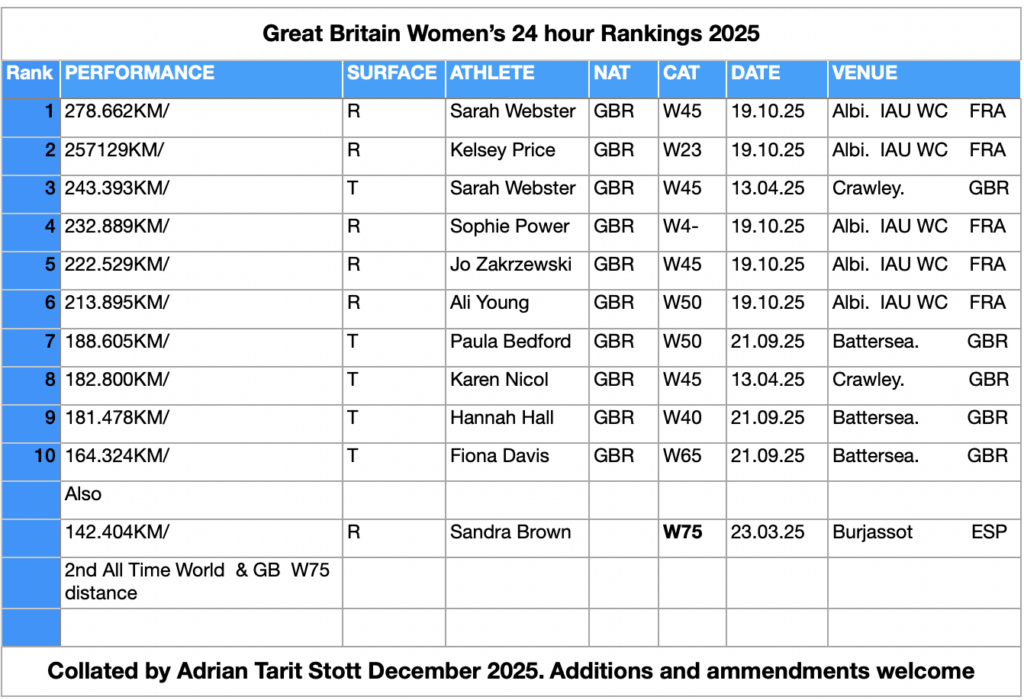
Sarah Webster, in one of the most exceptional performances by a British athlete, leads the women’s 24-Hour rankings for 2025, with her World Record, set when winning the IAU World Championships in October at Albi.
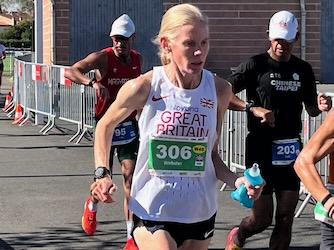
Her distance of 278.662 Km (173.152) beat the previous world record, set by Japan’s Miho Nakata at the last World Championships in 2023, by over 8 Km (5 Miles).
It also improved the European Record previously held by Patryjca Berezknowska 263.178 Km, in 2024, and the British Record of 247.984 Km, set at the 2022 European Championships by Jo Zakrzewski.
Kelsey Price continued her emergence as a world-class ultra runner. Her 4th place at Albi, with 257.129 Km, also broke Zakrzewski’s previous British record, putting her 2nd in this year’s GB women’s rankings.
Webster’s only other 24-hour, at Crawley in April, where she ran 243.393 Km, was the third best distance of 2025.
Sophie Power with 232.889Km in Albi, along with Jo Zakrzewski’s 222.529 Km and Ally Young’s 213.895 Km, fill the next placings.
Webster’s gold medal at the IAU 24-hour World Championships capped an incredible three-year spell since moving up from the marathon to ultra distances in the spring of 2023. In that short time, she has claimed bronze medals at both the IAU World 50km Championships in 2023 and the IAU 100km World Championships in 2024.
Read our chat with Sarah Webster following her first 24 hour experience in April 2025 at the Crawley 24 hout HERE
Men’s 24-Hour 2025
While it has been a truly exceptional year for the women at 24 hours, the same cannot be said for the men.
With the exception of the COVID-affected year of 2020, you have to go back to 2017 for a year when no British male surpassed 250km.

L-R Chris Kelly. Matt Field, Dan Lawson, Robbie Britton, Paul Maskell, Ben Wernick
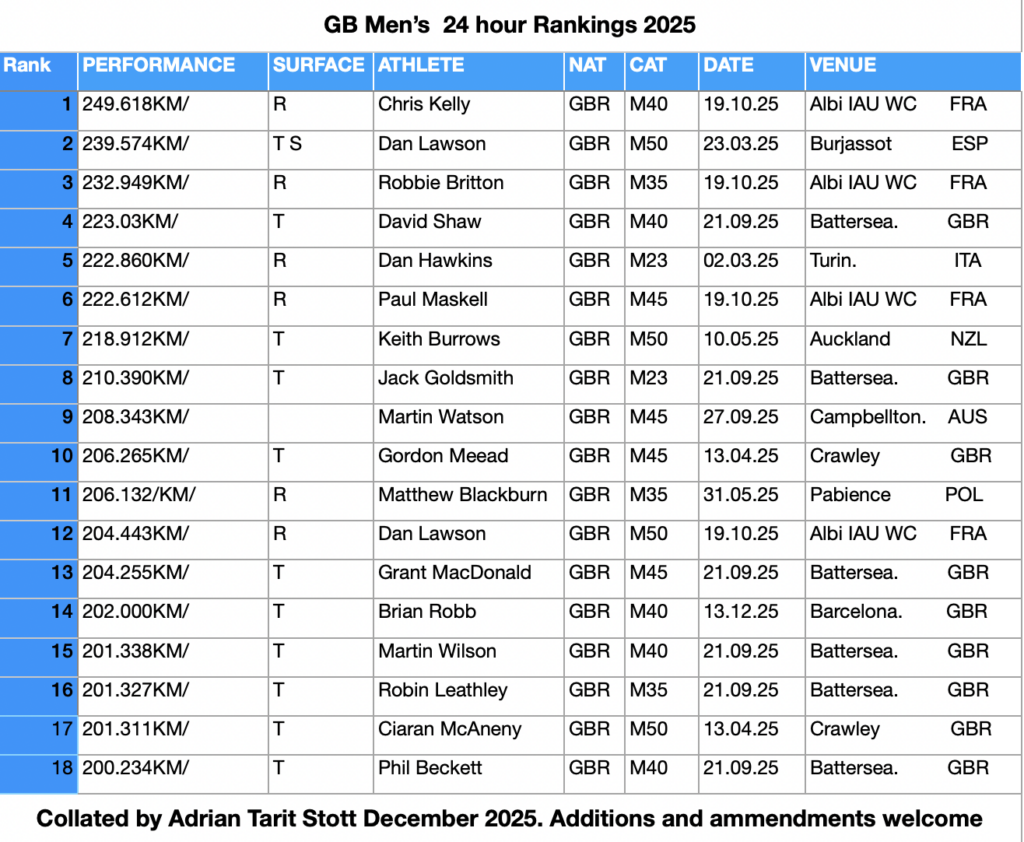
Chris Kelly, with his 249.618 Km, came close in Albi at the World Championships. Dan Lawson with 239.574Km earlier in the year in Spain, and Robbie Britton with 232.949km at Albi, filled second and third spots.
To put this into some perspective, Sarah Webster and Kelsey Price’s distances were the best by British athletes this year.
World Leads for 2025
Sarah Webster, with her world record at Albi, leads the global rankings for 2025 ahead of the silver and Bronze medallists, Holly Ranson and Miho Nakarta.
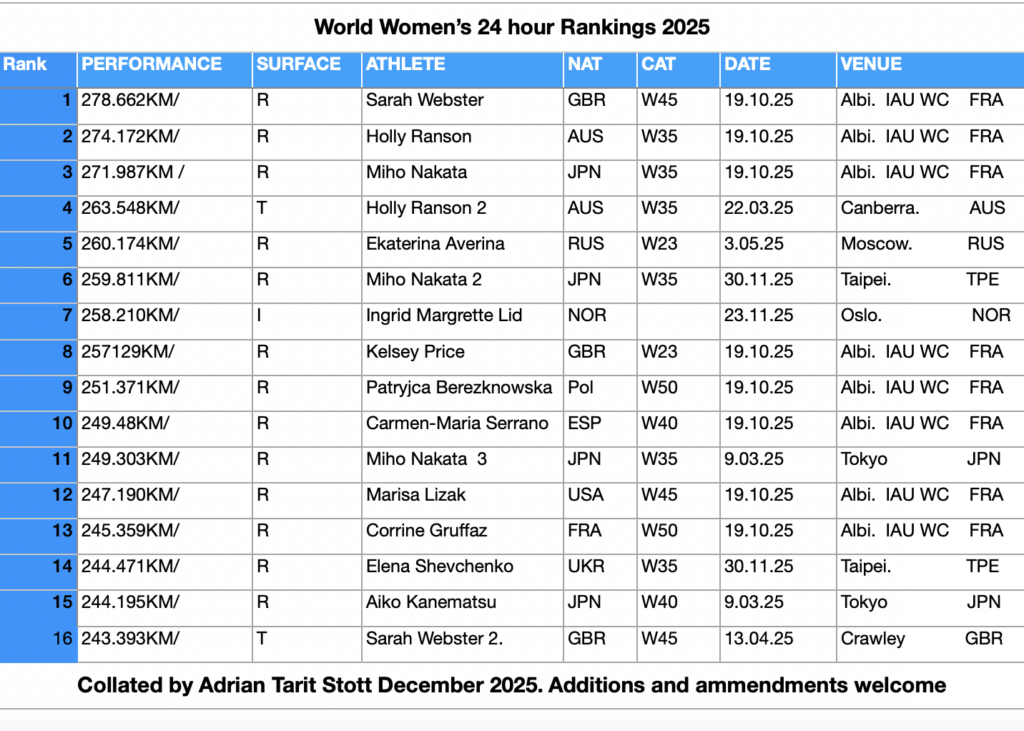
Australia’s Ranson and Japan’s Nakata, 2nd and 3rd at Albi, also surpassed the previous world record, and will mark the Albi championships out as a defining moment for the women’s 24-hour development.
In total, there were eight women’s performances over 250Km this year, a measure of the improvements in performance, when 10 years ago only Japan’s Mami Kudo had bettered the distance.
Of the top ten female performances at 24 Hours in 2026, six were set in Albi, with Nakata and Ranson achieving two of the other four top ten distances in other races during the year. Ranson, running the 4th best distance of 263.548 Km in March, and Nakata, only 5 weeks after Albi, running 259.811Km in winning in Tokyo on 30 November.
Ekaterina Averina showed that despite the lack of international opportunities, Russian athletes are still capable of posting good distances at home, with a 260.174 Km effort in Moscow in May.
Late in the year,on the 23rd of November, Ingrid Lid of Norway ran 258.210Km in Oslo
Kelsey Price, along with Webster, made a big breakthrough on the World stage. Her 257.129Km for 4th place in Albi rockets her into the top 10 all-time women, among some illustrious company. She is certainly one to watch for the future.
Read our blog, “The Women Stole the Show,” that I wrote for Run Ultra HERE.
Andrii Tkachuk, with his 294.346KM(182.898 Miles), topped the Men’s global rankings with his victory at the IAU World Championships.
Seven of the world’s top 10 distances were achieved at the Albi race.
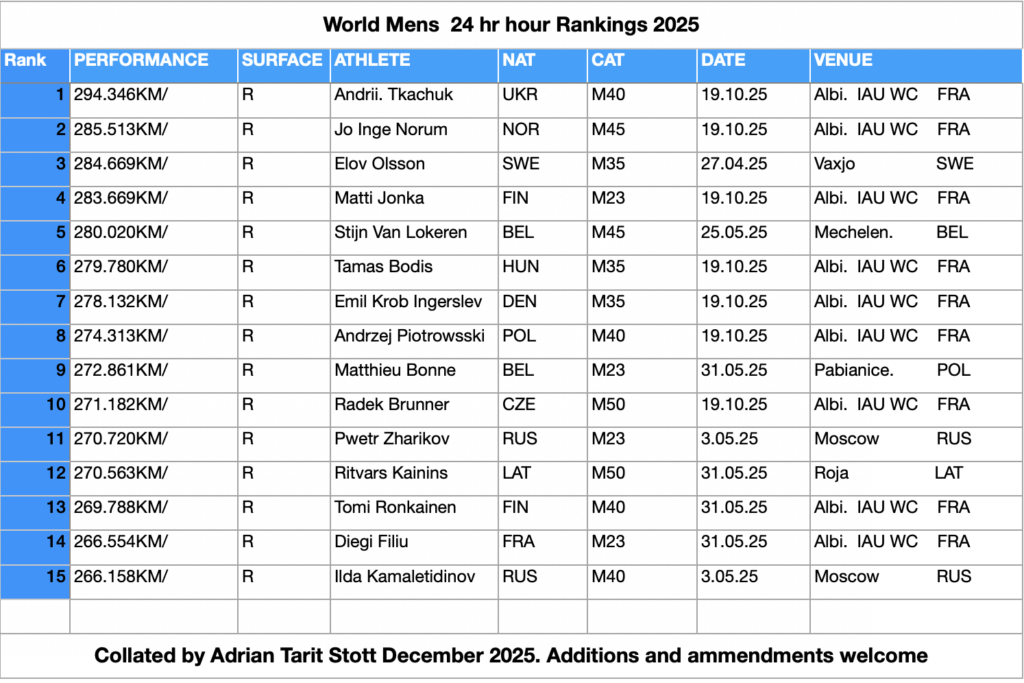
Scandinavian runners made a big breakthrough with their performances this year, filling the next three places in the rankings. Jo Inge Norum (Norway), Elov Olsson (Sweden) and Matti Jonka (Finland) all set National Records, as did Hungary’s Tamas Bodis and Denmark’s Emil Ingerslev in 6th and 7th place in the annual rankings, respectively.
Stijn van Lokeren of Belgium, with his 280.020 Kilometres at Mechelen in May, also set a national record.
Leaving aside the role that supershoes may be having on 24-hour performances, it is encouraging to see more runners from more nations taking the 24-hour event seriously.
You can read a full global ultra overview I wrote for Irunfar HERE
Other Notable mentions
The seemingly evergreen Sandra Brown, at 76 years old, was just over a kilometre outside her own World and British Masters F75 record with 142.404 Km set at the Burjassot race, in Spain, in March.
Thanks for reading. If you have enjoyed this post, do see our other ones HERE
If you have a comment, please feel free to add it below.
If you are inspired by this, or think someone else you know will be, please do what you have to do by sharing. You all know how these things work by now:-) You can also follow me on Twitter and Instagram @tarittweets
Sign up to receive our newsletter alerting you to new posts
Adrian Tarit Stott.
The author is a former GB 24-hour ultra international with over 100 ultra race completions. He has also been involved in organising ultra-distance races for over 30 years. Still an active recreational runner, he is currently a member of UKA’s Ultra Running Advisory Group (URAG) and the Mountain and Trail Advisory Group. He also contributes as part of the selection and team management for both Scottish and GB ultra teams. A freelance writer in his spare time, he contributes articles and reports to several websites and magazines including Athletics Weekly and Irunfar.


