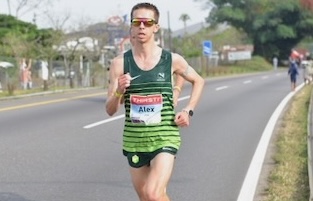
Alex Milne talks Comrades Marathon
The Comrades Marathon is one of the World’s iconic and oldest ultra races. The race covers a 90km distance between Durban and Pietermaritzburg. First run in 1921, the course alternates direction each year. The “UP” run is from Durbam to Pietermaritzburg. The “DOWN” run is in the opposite direction. This year, a down year, was the 98th running of the event. Great Britain international, Alex Milne, has an impressive recent record at Comrades. He was 15th in 2023, 9th in 2024 and this year placed 6th. We caught up with Alex for a chat after this years event, which was held on June 8th.
Who is Alex Milne
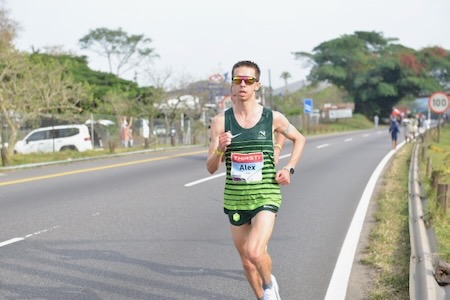
AS. Who is Alex Milne and where are you now? Where is home? Where are you sitting at the moment?
AM. I’m currently sitting at my parents’ house in Hertfordshire.
Home for me is Southwest London, so near Wimbledon.
AS. And what do you do for work?
AM. I’m a Maths teacher. I’m actually part-time at the moment, just working three days at school. Then, on the other two days, I tend to do some private tutoring.
AS. And how do the important things in life, like running, fit around that?
AM. I try to make it work, especially since it’s a bit tricky with a 21-month-old boy now.
I try to fit it in around childcare and teaching. I run to work and back, and do lunchtime sessions if I can find a few gaps in the day. It tends to work fairly well. I’ve also got a very supportive wife who is happy to look after Laurie when I’m training.
AS. The family and friends support crew is very important. Briefly describe how you got into running. Were you sporty at school, or did it just happen by accident, or how did running start for you?
AM. I suppose it was probably through my school’s cross-country. We had an annual school cross-country race. I went to a little school near the M25 motorway, in the Enfield and Potters Bar area. I remember the route went down under the M25, and then it was like a big loop around the other side. Most of the kids didn’t take it that seriously. Often, you had to avoid being tripped up on the first big downhill, but if you got out hard enough, they couldn’t catch you. I found I was quite good at cross-country without doing any training and mostly enjoyed it, although I was often sick at the end of the race, because I pushed myself so hard. So yeah, I guess it was through school cross-country races. I didn’t start actually training for races until I was 17 or 18, when I ran the London Marathon. The first time, when I was 18. So this would have been the 2008 London Marathon.
I ran it for charity, raising money for a friend of mine who had a spinal injury. Everything started from there.
AS. After that first marathon, did you start getting into more structured training, for want of a better word, and link up with a club??
AM. Yes. After that first marathon. I dropped the distance down massively from marathon to 1500 metres. I then tried to slowly work on my 1500 and 3,000 metre times a little bit. I joined Enfield and Haringey, and one of the coaches there was very, very helpful.
AS. Your power of 10 lists your many club activities from 1500 metres through to the marathon., When did you first start getting led astray into the possibility of running an ultra?
View Alex’s Power of Ten HERE
From Marathon to Ultra.
AM. I was always drawn to the ultra side of things, just from reading about it and hearing all the stories. I guess I didn’t run my first ultra until 2019, which was the 50k World Championships in Romania. That is, if you count 50k as an ultra. I was selected due to my improved marathon time.
I ran a few other 50-kilometre races, but my first longer ultra was Comrades two years ago in 2023.
AS. Are you self-coached or do you have a coach?
AM. Self-coached.
AS. But do you have any friends or people whose opinions you value that you bounce ideas off at all?
AM. I guess I have training partners and running friends I know I can contact. I’ve asked people like Robbie Britton a few questions now and then, especially around heat training, which I’m fairly new to.
AS. Having that little network of people to bounce ideas off is always helpful. Have you more or less concluded that you can work out for yourself what your optimal training load is without crossing any red lines?
AM. I’ve been fairly good over the last few years and not pushed myself too hard. I have mostly avoided injury, so I think I know what I’m doing. It could be beneficial to have a coach, but it just feels like it’s an extra time commitment, which I don’t feel I have at the moment.
AS Fair enough. For anyone reading this who’s thinking of moving up from marathon to 50K, or even 100K. What differs in training? Or is it more of a mindset of being able to handle those extra five miles?
AM. I would say that for 50 kilometres, it’s just a mindset. Maybe your longer runs are just slightly extended compared to marathon training.
AS. Which is a classic answer. In terms of moving up to Comrades or 100k, does the training change much?
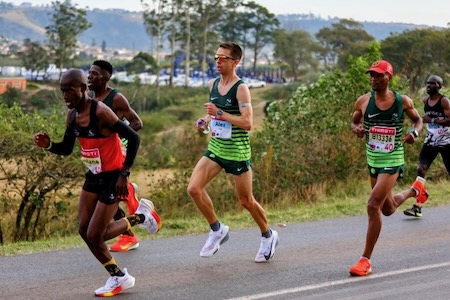
AM. I would say yes. Longer runs are needed. Also, for races like Comrades, which isn’t flat, you need to actually train specifically for that terrain. I guess I made that mistake two years ago at my first Comrades. I didn’t really train for the long downhill sections. Whereas this year, the few long runs I did were very specific to the course. So yeah, longer runs for the longer ultras, obviously, More stuff at race pace, because once the race is longer, you’re able to run at race pace more easily in training.
Also, just try to match the course profile in your long training runs.
AS. You’ve answered two or three questions there, all in one.
What does Comrades involve? It involves a few hills.
AM. Yes, pretty much. I had a very, very boring loop that I used. It was sort of a loop. It was a bit of an up and out and back. Then a loop at the bottom. I just drove down to near Box Hill and did repeats up and down this hilly section there. 3 km up and 3 km down.
AS. That doesn’t sound unlike what Henry Hart did when he found out that Mallory Park, the venue for the ACP 100 Kilometre this year, wasn’t going to be flat. He altered his training, I think, from the Thames Towpath to Richmond Park, just to include undulations.
Note Henry Hart won the British Championship 100km race at Mallory Park in May. You can read a post race chat with Henry HERE
So, this was your third Comrades if I’ve got my sums right. You’ve done one uphill and two downhill.
AM. That’s right.
AS.Which is harder?
AM. I would say the down after this year’s race.
AS. Why do you think that is? Many people would think that going downhill with assistance from gravity should be easier, but you are saying it’s not.
AM. I think if the long downhills came earlier in the race, it would probably be easier. Obviously, there are downhill sections earlier on, but the majority of the downhill is in the last 30km-35km of the race. I think when your legs are already extremely fatigued, and then you’ve got some quite steep downhill sections that go on for two or three kilometres, plus the camber of the road, it just adds to the overall pain and fatigue, especially in your quads.
AS. Have you done any work to strengthen your quads, or is it just something you have to suck up and just go with it?
AM. So, the only work I did was running work, so no actual strength work, but yeah, I mean, on the downhill sections of that, that out-and-back loop I just described, I was trying to hit the downhills a lot harder than the uphills. Aiming to throw myself downhill as hard as I can to batter the quads a little bit in training.
Comrades Iconic Start
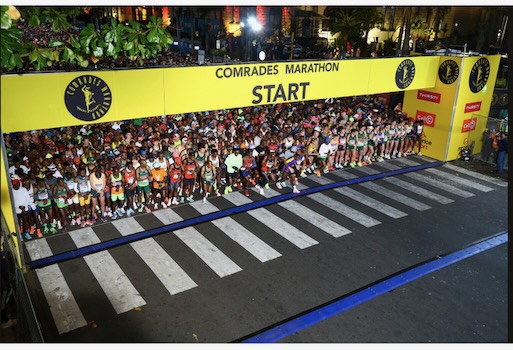
AS. Most ultra runners have seen pictures of the iconic Comrades start just before dawn. Describe what it’s like being on the start line at Comrades with all the big buzz going on. Are you trying to be quiet and stay in your own little zone, or is it very difficult not to get caught up in the whole adrenaline rush?
AM. I’d say it’s very difficult, especially in your first comrades. It’s quite an emotional experience, and it’s very exciting finally being on the start line, standing there in the dark and listening to all the songs as they go through the standard routine. You have to try not to get carried away as soon as the gun goes off. I mean, one of the runners, I don’t know if you saw the video this year, but one of the runners absolutely shot out. Looking like a 100-meter sprinter for the first few hundred meters, but he kept it up until around 70k, when he was caught.
NOTE. Onalenna Khonjhobe won the Two Oceans Marathon in South Africa in 2024. He led Comrades by over 2km at one stage this year, before finally being passed around the 75km point, dropping soon afterwards.
AS. You never know. On another day, it might work. I remember, as a classic example, seeing this in a 24-hour race. I think it was the 2016 European 24-hour championships in Albi. There was a young, fresh-faced athlete taking part, who just blasted it off full of confidence and led for the first 18 hours, until Dan Lawson caught him up and went on to win. the young ambitious runners hung on but faded to finish 6th
AM. Oh, wow.
AS. A lot of people said he was just an idiot doing this. But some more experienced and worldly-wise runners, like me, were looking at him, knowing he had run a couple of very good 100km races and a respectable 24-hour distance, saying, “Well. He’s obviously got a bit of talent. If he can just work at it for a couple of years and get this right, he’ll do something quite phenomenal. ” The runner in question was Alexsandr Sorokin, and it hasn’t turned out too bad for him. So what I am saying in a roundabout way is don’t write off that guy who went out hard this year.
AM. Definitely. I mean, yeah, the guy who did go out hard has won Two Oceans before.
AS. He may get it right on the day one year.
The Nedbank International Team.
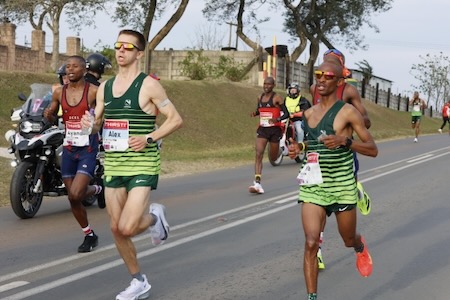
AS. So this year, you were part of the Nedank International team. Was it the first year you were part of the Nedbank team?
AM.No.
AS. So, for any aspiring runners thinking of going to Comrades at your level, how do they get involved with the Nedbank team? Also, what is the Nedbank team for runners who might not be aware of it?
AM. So, I guess it’s a local South African team, and they tend to support international runners as well who want to run Comrades. Nick Bester is the main guy to contact if you’re looking for a place. Basically, they give you accommodation, they sort out all the race day logistics, all of the transport before and after, and meals are provided. It’s quite useful knowing a lot of the stuff you would have normally had to think about yourself is taken out of your hands, and they can sort it all out. It’s a bit easier now that they have elite drinks on the course, too. I think the first year that I ran Comrades, there were no official drink stations for elite athletes, whereas the last two years, they’ve actually been elite drink stations.
But Nedbank also offer additional support stations. I think we had eight extra stations this year, where you can make your own drinks for those ones as well.
AS. Right. And is this the classic drop bag situation? You just leave them all with the Nedbank guys, and they make sure they’re in the right place at the right time?
AM. Pretty much. Yeah. So you label the bottles and they’ve got numbers for each station. The nice thing they do is they also pay a bonus if you finish in the top 10, in addition to the prize money that Comrades give you.
AS. So that’s a little bonus you’ve taken advantage of the last couple of years. It all helps, I’m sure.
AM. Exactly.
How the race unfolded.
AS. I’m always aware that at the start of Comrades, there seems to be this huge pack that goes off fast. A lot of people are local South Africans and runners. As the race progresses, how does that pack start to split up? Is it really some kamikaze guys in there, or is it a pack working together?
AM. To be honest, I don’t really know because I think this year was the first time I’ve actually gone with the pack. I felt like the pace wasn’t too suicidal. So I hung with the pack for as long as possible. It seemed this year that most people who dropped off were just fatiguing and couldn’t hang with the pace anymore.
AS. So they just gradually faded and dropped back.
AM. Pretty Much. It just got whittled down from maybe 50 or so runners for the first 20 or 30 kilometres of the race, to maybe 25 or 20 guys, I would say, by around 60k into the race.
AS. So gradually gaps start appearing. In the latter stages, did you ever feel you were in no man’s land or where there were always people to chase?
AM. Yeah, definitely. There were some sections over the last 30k where I couldn’t see anyone ahead of me, and I couldn’t see anyone behind me. It felt quite disheartening that I maybe had 40k to run, and I had to let the lead pack go. I felt like I had nothing left in my legs, and the hills, especially the uphills, were taking a lot out of me. I thought there was no way that a top 10 place was going to happen this year. I saw so many runners move away, and they seemed so strong. I almost lost hope at that point. But yeah, they started coming back to me.
AS. You managed to finish in the top six this year.
AM. I was also quite lucky that I passed three guys in the last 7k of the race, sort of evenly spaced. So actually, the last 7k, I could see someone quite far ahead, and I could see they were tiring. So I had someone to work towards during those last 7k.
AS. People who’ve watched Comrades on live streams or post-race videos will know there is a lovely tradition of the Comrades gold medalists getting handed a flower to carry to the finish.
AM. That’s right. We get given a red rose. The top 10 males and females are given one.
AS. How far out are you given that rose?
AM. I think it’s about 300 to 400 metres before the line.
AS. Finishing, comrades.
Try to describe what it is like finishing Comrades. How is it compared to something like the London Marathon, which I know you’ve run several times? Are there crowds lining the route all the way or just as you come into Durban? Does it noticeably get noisier?
AM. Some stretches are extremely noisy, and there are quieter patches. In general, there are crowds pretty much along the entirety of the 90-kilometre route. I would say the finish is the loudest section. I just remember running down the finish straight, overjoyed that I could finally stop running. Everyone had these rubber or plastic things they were hitting against each other or on the side of the stands.
It’s just this deafening roar. It felt very surreal. And yeah, I mean, my vision was starting to go at that point as well.
AS. So on a different planet.
AM. Also, the rose that the top 10 finishers receive was handed to me by Caster Semenya, which we didn’t find out until the actual moment.
Note: Caster Semenya is the South African track athlete who won Olympic, World, Commonwealth and African titles at 800 metres and Commonwealth Gold and World Bronze medals at 1500 metres.
You knew someone special was going to be handing it to you, but you didn’t know who it was until the actual moment.
But yeah, we all had dinner with her that night.
AS. That was post-race, you had dinner with her, yes?
AM. Yes, that’s right. That was a surprise, too.
Comparing Comrades with other major races.
AS. Nice little touch. So that’s pretty much the race. Well, just a final thing on the race. You’ve run for England at the Anglo Celtic Plate and you’ve run for Great Britain at the World 50km and 100km Championships, which is quite a high-level race. How does something like Comrades compare with running the world championships?
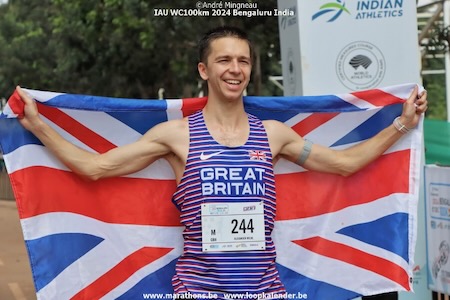
AM. I mean, Championships are great, with some great runners, but the fields are fairly small. Comrades feels a lot more competitive. Just the number of athletes that are totally going for that top 10 spot. Everyone’s just pushing each other the whole way. It feels like, I don’t know, I guess with a huge pack going for it from the start, it seems more of a serious race from the gun and more of an exciting race. Then, I think the crowds along the whole route just add to that support. The other thing with the crowds is that often you get a Tour de France-type situation where they all bunch in near the top of the hill, and you’re running through this tunnel of people screaming at you on the side. Also, they are doing things like throwing water at you, running after you and spraying Deep Heat on your legs. It’s quite an amazing experience.
AS. You weren’t the only British runner to place in the top 10. South African-based Carla Molinaro ( 5th) and Melissah Gibson in 10th did well too, and Ireland’s Catriona Jennings placed 8th. Just outside the top 10, Naomi Mitchell, in her first long ultra-race, ran a superb 15th place.
AM. I think Naomi was a little bit disappointed, but still, it was a great run for her first Comrades.
Nutrition and Shoes
AS.Okay. A couple of things that are slightly tangential to the race. Nutrition-wise, are you the sort of guy who measures out your maximum number of carbs per hour you can take and tries to go with that? Or is there a bit of flexibility?
AM. So I used to have a lot more, I guess you could call it flexibility, or not really knowing what I was taking or how much. Since the 100km in India, I’ve been trying to maximise carbs per hour, caffeine and sodium, etcetera. So instead of trying to hit the much higher numbers in this race, I think in the end, I averaged something like 95 grams of carbs per hour. I also had some difficulties early on in the race, with stomach trouble for the first 30 Km or so, which limited how much I could take on early in the race.
I also had quite a lot of caffeine, maybe 600 milligrams of caffeine across the entire race.
AS. Are you taking on caffeine early on, or are you waiting until later in the race?
AM. I started early on. I had a caffeine gel just before the gun went off, then I had one every hour and 15 minutes or so throughout the race.
AS. You’re certainly doing something right, anyway.
AM. I guess so, yeah.
AS. I was chatting with Henry Hart about this as well. Are you practising taking on what you feel is your optimum carbo load on your long training runs? So you’re adapting the gut to it rather than just giving it a big shock on race day.
AM. Yes. Exactly. I’m practising. The two longer runs I did for training before Comrades, I was taking on a hundred, and I think I managed 110 grams an hour in those. I even felt like I could have handled more, as it felt like I was a little bit low on sugar.
AS. Is that something that you’ve generally adapted to over time? I mean, like, say three or four years ago, could you have handled that many carbs in an hour in a race?
AM. That’s a good question. I guess I didn’t try, so I don’t know the answer.
AS. It’s a very honest answer, though. Okay. The other vital thing that people love to know, and the world waits with bated breath to hear, is what shoes you wore in the race?
AM. I actually went with the Alphafly 3s.
AS. Okay.
AM. It seemed not to be the choice for a lot of the top guys. I saw a lot of guys going with Vapor Fly 3s, or the first and second-place guys were.
I just found the Alpha Flys, although they are a little bit heavier, the bounciness feels more comfortable, especially as you get into the later kilometres of the race.
AS. Obviously, you use those for racing. What do you use for most of your training miles?
AM. ASICS Super Blast are what I run a lot of my training miles in. Again, very supportive and big stack height. I think they’re actually illegal to race in because the stack height is so much. It seems to work well for me in terms of recovery, though.
AS. So, looking at an overview of the ultra scene at the moment, or just your own training, you’ve evolved into a very competent, international class 50k and 100k runner. Is there any magic wand you can wave to get to that level? Or is it just keeping doing the simple things very well year on year?
AM. I suppose it’s a combination. I wouldn’t say there is a magic wand. I suppose it is just consistent training, as you say, year on year, gradually ramping up the mileage. The consistent training means that you aim to avoid getting injured. So you have to be careful about ramping it up too quickly.
I think the other thing that has helped me is the fueling. So, if you can get the fueling right and you practice it in training, then actually, you can outperform your competitors on race day.
Another thing that has helped me is heat training. I’ve done more heat adaptation for all of my recent races in India and South Africa. I’d say that has helped lead to PBs across most of the distances,
AS. So, for a northern European living and training at home, who is going out to a very hot or humid race somewhere, how have you incorporated heat training in the few months building up to a race?
AM. Yes. So I’ve actually left it quite last-minute for some of my races, and it still seems to have worked. Things like taking a hot bath every day for seven or eight days before a key race seem to be enough to create a good number of adaptations. So, 30 minutes at 40 degrees Celsius.
Trying to submerge yourself as much as possible seems to work pretty well.
AS. Do you ever do any saunas before or after a run?
AM. I did do some sauna stuff before the 100k in India. But sometimes the sauna was busy. So I was a bit worried about getting an illness or an infection from someone else sitting in there.
Before the London Marathon this year, I was actually in Florida for a few weeks on holiday. So obviously, just running in Florida, and the warm conditions were enough for some heat training.
What’s Next for Alex?
AS. OK, final question. What’s next for Alex?
AM. That is a very good question because I haven’t really thought about it myself. I told myself I’d have a full week off after Comrades, which I’ve had now, and then plan something else for later this year. I have a place in the Loch Ness Marathon towards the end of September and also a place for the Valencia marathon in the early December which has the opportunity for a fast time , so ideally, I can take a few more seconds off the marathon time there.
In terms of ultras, I haven’t actually given it that much thought. So I need to plan the next phase.
AS. Just on that, for any competent marathon runners, or anyone at any level, really, but especially people running sub 2:30 marathons, thinking of moving up to 100k. What’s the best advice you would give them?
AM. I guess choose your race first of all, and choose an interesting race that actually excites you, as you want to be motivated to train for it. If it is Comrades, then yeah, make sure you are getting in those longer runs, maybe up to 70 km..
Just gradually ramping up the mileage before that race. I think the key is if you can do some longer runs at close to race pace, then you’d probably be okay on race day.
AS. Obviously, events like comrades are all on tarmac. Do you do all your training on tarmac? Or do you try to get onto trails? I’m not saying technical trails, just towpaths and things that are slightly softer impact for the longer runs? Does that help at all?
AS. I think so, yes. I definitely do try to avoid tarmac if I’ve got high mileage weeks, but then some things like my key runs will be on tarmac just to try and simulate the race day conditions and adapt the legs a little bit better. I don’t know too much about trail running. I guess I haven’t really got into that side of things yet, but maybe over the next few years I’ll try and strengthen my ankles and jump into a longer trail race like the West Highland Way.
AS. Other options are certainly available! Thanks for the chat Alex.
AM. Your welcome.
With my known involvement with the West Highland Way Race, I am not sure if Alex was humouring me or will indeed turn his attention to the trails at some point. His basic speed on the road where he has PB’s of 29:45 for 10km, 2:14:03 for the marathon, 2:51:25 for 50km and 6:43:21 for 100km certainly show where his current strength is. Whether he could translate that speed onto runnable or more technical trails, time will tell.
Thanks for reading. If you have enjoyed this post, do see our other ones HERE
If you have a comment, please feel free to add it below.
If you are inspired by this, or think someone else you know will be, please do what you have to do by sharing. You all know how these things work by now:-) You can also follow me on Twitter and Instagram @tarittweets
Sign up to receive our newsletter alerting you to new posts
Adrian Tarit Stott.
The author is a former GB 24-hour ultra international with over 100 ultra race completions. He has also been involved in organising ultra-distance races for over 30 years. Still an active recreational runner, he is currently a member of UKA’s Ultra Running Advisory Group (URAG) and the Mountain and Trail Advisory Group. He also contributes as part of the selection and team management for both Scottish and GB ultra teams. A freelance writer in his spare time, he contributes articles and reports to several websites and magazines including Athletics Weekly and Irunfar.


